The Story of ‘Veni
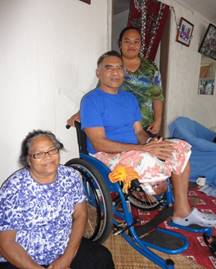
‘Veni was a 60-year-old man with a very large extended family. He had worked as a security guard at the Lagoon Lodge in Nuku’alofa, capital of Tonga, providing for his large family. One of his daughters also worked at the same facility as a house maid.
John Macdonald and the team of the St John of God Twinning program regularly stayed at this facility and John got to know Veni as a quiet and friendly man. On one of those trips it came to light that ‘Veni had lost his leg due to sepsis (infection) following development of a foot blister at work. No prosthetic service was available for ‘Veni and overseas treatment was not an option due to financial constraints. He was confined to a wheelchair and unable to work.
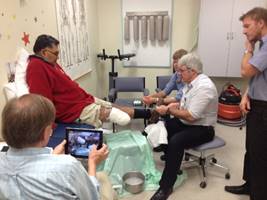
Peter Lendfers, an Orthotist at the Ballarat Health Services, was keen to help and a collaborative Social Outreach effort between St John of God Hospital Ballarat and Ballarat Health Services saw ‘Veni visit Ballarat to have a prosthesis fitted.
The prosthesis went well and ‘Veni was up and walking in the first week. Unfortunately, unexpected and unrelated health issues complicated the visit so ‘Veni spent five weeks at St John of God Hospital Ballarat before he returned to Tonga.
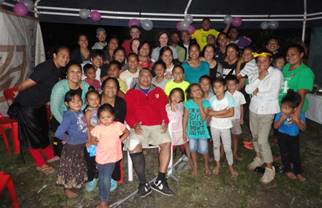
`Back home in Tonga, ‘Veni recovered and was delighted with his new leg – even returning to work. A proud moment was walking up the steps at church (to everyone’s amazement)! He didn’t use a wheelchair again.
The experience gave valuable insight into the future of prosthetic care in Tonga – it would be much easier, more economical, and far more effective to provide prosthetics in Tonga than try to seek these services in other countries.
Why Vaiola Hospital and Tonga need their own prosthetic service:
- They need local Tongan prosthetists:
- To communicate with patients and family in their own language
- To be aware and sensitive to local culture and traditions.
- They need a female prosthetist: Supporting the education and training of a female prosthetist is essential to provide service to female amputees in a sensitive environment. Gender balancing of the work force is a good policy to ensure needs of female population are advocated for. In Ausralia the genders within the prosthetic and orthotic industry are close to 50 % male and 50% female.
- They need prosthetists to provide immediate post operative treatment, and to provide early rehabilitation with rigid dressings to prevent swelling, to protect the stump and facilitate healing.
- They need to provide every amputee with access to the service (anecdotally there are more then 1000 amputees in Tonga).
- They need to provide amputee education around self management (for the patient and for family members).
- They need to provide gait training with a prosthesis to all amputees.
- They need to maintain and repair existing prostheses so decrease costs and maintain independence of the patient.
- They need toprovide appropriate technology to meet the needs of every individual amputee
- They need to promote prevention of amputation
- They need to provide physical facilities and resources so a service can be delivered.
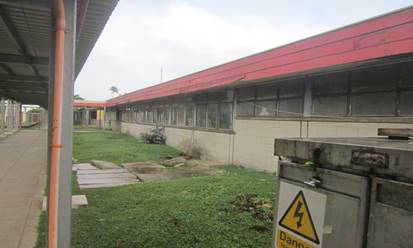
This building on the left will be renovated to accommodate the Mobility clinic including the prosthetic service. Funding has been provided by the Australian Department of Foreign Affairs and the Ministry of Health in Tonga. Unfortunately in setting up the program, the lack of a female prosthetist was overlooked.
It will be sustainable
- Local ongoing service will attract basic funding
- A mentorship program can be set up with Australian, US or NZ prosthetic facilities
- The prosthetic service will be embedded in an extended mobility service also providing:
- Wheelchair service (to WHO WSTP standard)
- Walking aids (to MA standard)
- Lower limb orthotics (to ISPO standard)
- Short term device loan scheme
- Physiotherapy and some aspects of broader rehabilitation
___________________